
Incident Reports Template
When something goes wrong at work — an injury, a near miss, property damage or a security incident — a clear report written promptly is the foundation for helping people, meeting legal duties and preventing it happening again. This pack gives you editable report forms, a witness statement, an investigation template and a corrective action log.
- Instant download
- Editable Word & Excel
- Print-ready PDF
- 7-day refund
6 files · DOCX, PDF, XLSX
Incident Report Template Pack
Editable incident report, near-miss report, witness statement and root-cause investigation forms, plus an Excel corrective action log and incident register.
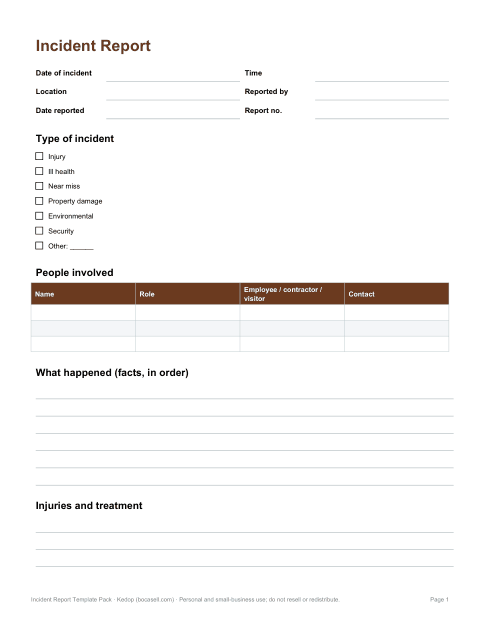
- Incident report form (DOCX, PDF)
- Near-miss report (DOCX, PDF)
- Witness statement (DOCX, PDF)
- + 3 more
$7.00 USD, one-time 6 files · about $1.17 each
- Instant download
- 7-day refund
- Secure checkout by Stripe
7-day money-back guarantee. Full refund within 7 days of purchase, even after you download.
Free sample: Incident Report Form (PDF, 52 KB)
Incident Report Template Pack
Editable incident report, near-miss report, witness statement and root-cause investigation forms, plus an Excel corrective action log and incident register.
- Incident report form (DOCX, PDF)
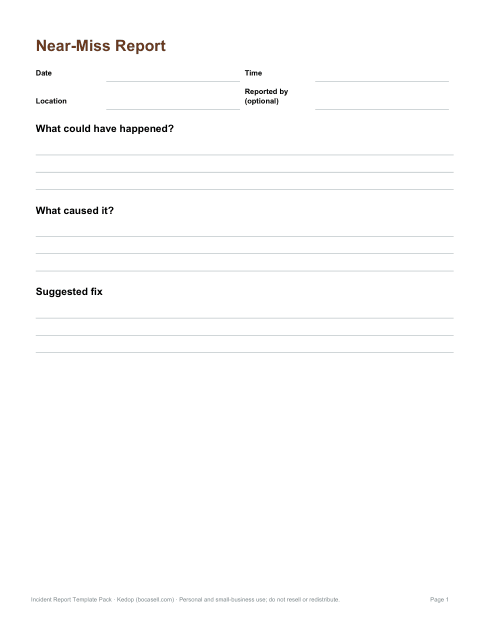
- Near-miss report (DOCX, PDF)
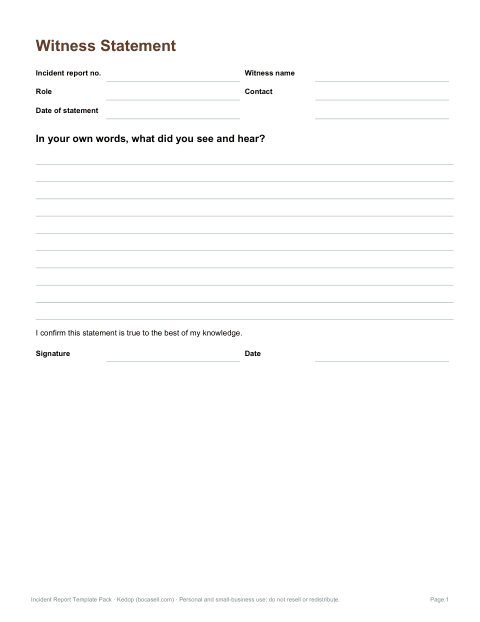
- Witness statement (DOCX, PDF)
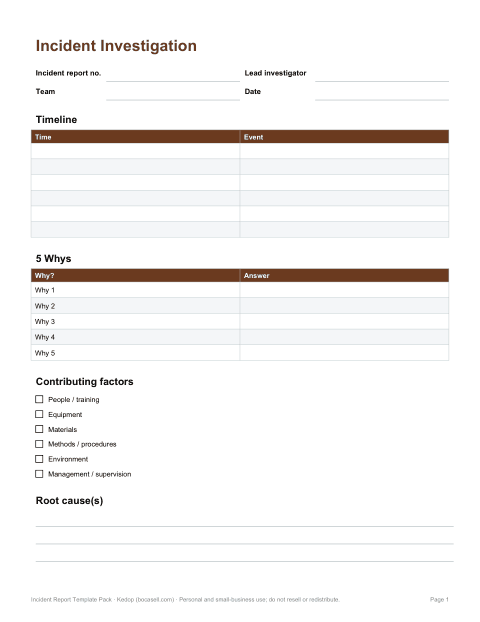
- Investigation form (DOCX, PDF)
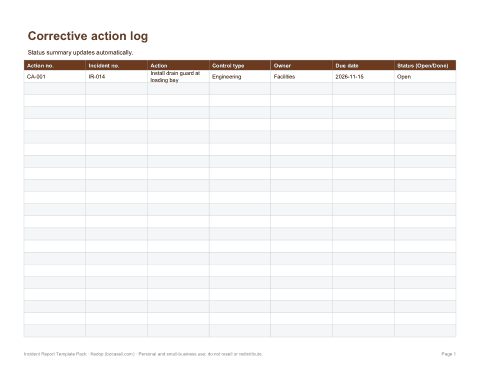
- Corrective action log (XLSX)
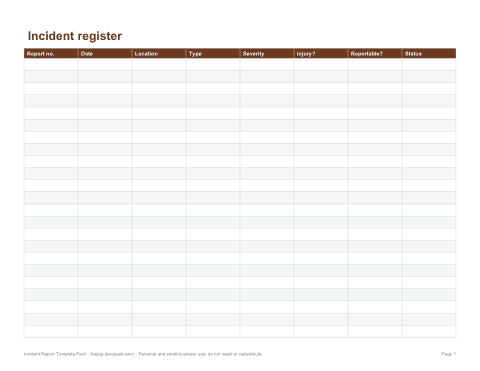
- Incident register (XLSX)
Formats: DOCX, PDF, XLSX. Instant download after payment (link valid 72 hours, up to 5 downloads). AI-assisted: the templates were drafted with AI help and reviewed and laid out before publishing.
$7.00 USD, one-time 6 files · about $1.17 each
- Instant download
- 7-day refund
- Secure checkout by Stripe
7-day money-back guarantee. Full refund within 7 days of purchase, even after you download.
Free sample: Incident Report Form (PDF, 52 KB)
Full refund within 7 days — see the refund policy and license.
Free printables
Single sheets you can print right now, no sign-up. The full pack adds every sheet in one download plus the editable files.
 Printable Incident Report Form
 Printable Near-Miss Report Template
 Printable Witness Statement Form
 Incident Investigation Form
 Corrective Action Log Template
 Printable Incident Register Template
Templates in the pack
| Template | Purpose |
|---|---|
| Incident report form | Record what happened, who was involved, injuries, damage and immediate actions |
| Near-miss report | Capture events that could have caused harm but did not — the cheapest lessons |
| Witness statement | Record a witness’s own account in their words |
| Investigation and root cause form | Work out underlying causes using the 5 Whys and contributing factors |
| Corrective action log (Excel) | Track actions, owners, due dates and completion |
| Incident register (Excel) | Keep a running record for trends and reporting |
What to include in an incident report
- Date, time and exact location.
- People involved: names, job roles, contact details; and whether they are employees, contractors or visitors.
- What happened, in factual order — what the person was doing, what went wrong, and the result.
- Injuries or ill health: body part, nature of injury, first aid or medical treatment given.
- Property or equipment damage, and environmental impact such as spills.
- Immediate actions taken to make the area safe.
- Witnesses and their contact details.
- Photos, sketches or CCTV references.
- Name of the person completing the report and the date.
Stick to facts. Describe what was seen and heard, not opinions about blame. Opinions and conclusions belong in the investigation, which comes later.
Why near misses matter
For every serious injury there are usually many more minor incidents and near misses that share the same causes. A wet floor that someone almost slipped on, a load that nearly fell, a vehicle that almost struck a pedestrian — each is a free warning. Encouraging staff to report near misses, and acting visibly on the reports, is one of the most effective ways to improve safety. Keep the near-miss form short so it takes two minutes to complete.
Investigating the root cause
- Gather facts — visit the scene, take photos, collect statements and records.
- Build a timeline — what happened before, during and after.
- Ask “why?” repeatedly — the 5 Whys technique moves past the immediate cause (“the worker slipped”) to underlying causes (“the drain was blocked because no one was responsible for clearing it”).
- Consider categories — people, equipment, materials, methods, environment and management systems.
- Agree actions that address root causes, not just symptoms, and follow the hierarchy of controls: eliminate, substitute, engineer, administrate, then protective equipment.
Legal reporting duties
Many jurisdictions require employers to record and report certain workplace injuries. In the United States, OSHA requires many employers to keep records of work-related injuries and illnesses (OSHA Forms 300, 300A and 301 or equivalent forms containing the same information) and to report severe injuries — such as in-patient hospitalisation, amputation or loss of an eye — within 24 hours, and fatalities within 8 hours. In the UK, RIDDOR sets out which incidents must be reported to the enforcing authority. These templates are internal records; check which regulator forms and deadlines apply to your organisation and location.
Good practice for reports
- Complete the report as soon as possible, while memories are fresh.
- Use plain language and avoid jargon or abbreviations.
- Protect personal and medical information; share only with those who need it.
- Never alter a completed report — add a dated addendum instead.
- Review reports regularly to spot patterns by location, task or time of day.
- Tell the person who reported what was done as a result.
Who it is for
Small and medium businesses, facilities managers, HR teams, schools, construction and warehouse supervisors, event organisers and health and safety representatives.
Formats
Forms are editable Word files with PDF copies for printing; the corrective action log and incident register are Excel workbooks with status summaries.
Using the register to prevent incidents
An incident register becomes valuable over time. Sort by location, activity, time of day and type of injury to find patterns — for example, several near misses at the same loading bay in the late shift. Review the register at safety meetings, track how long corrective actions take, and look at whether the same causes keep coming back. Trends in near misses often predict where the next serious incident could happen.
Frequently asked questions
What should an incident report include?
Date, time, location, people involved, what happened, injuries or damage, immediate actions, witnesses and the reporter’s details.
What is a near miss?
An event that could have caused injury or damage but did not.
Is this the official OSHA form?
No. These are internal forms; use the OSHA forms or equivalents that contain the same information where required.
Are the templates editable?
Yes, they are Word and Excel files.
Was AI used to create the templates?
The templates were drafted with AI assistance and then reviewed, edited and formatted before publishing. They are not legal advice.